For the Love of Lyman Alpha
Our story begins in 2018 at Penn State University (We Are), where I studied physics and astronomy as an undergrad. Fresh off my first real astronomy course, I started working within the Hobby-Eberly Telescope Dark Energy Experiment (HETDEX) collabroation under Dr. Robin Ciardullo. HETDEX is an untargeted spectroscopic survey designed to detect and measure the positions of over 1 million galaxies called Lyman alpha emitters (LAEs). These positions will be used to measure the highly sought-after cosmological parameters at z~2-3. As a result of this cosmological effort, the HETDEX catalog contains millions of spectra from across the sky.
While HETDEX spectra are faint and low resolution, there’s power in numbers. Throughout undergrad, I developed spectral stacking techniques to increase signal and measure the Lyman alpha escape fraction from z~2 emission line galaxies. My investment in HETDEX and newfound passion for all things Lyman alpha led me to pursue a PhD at UT Austin under HETDEX PI Dr. Karl Gebhardt.
A Strange Signal
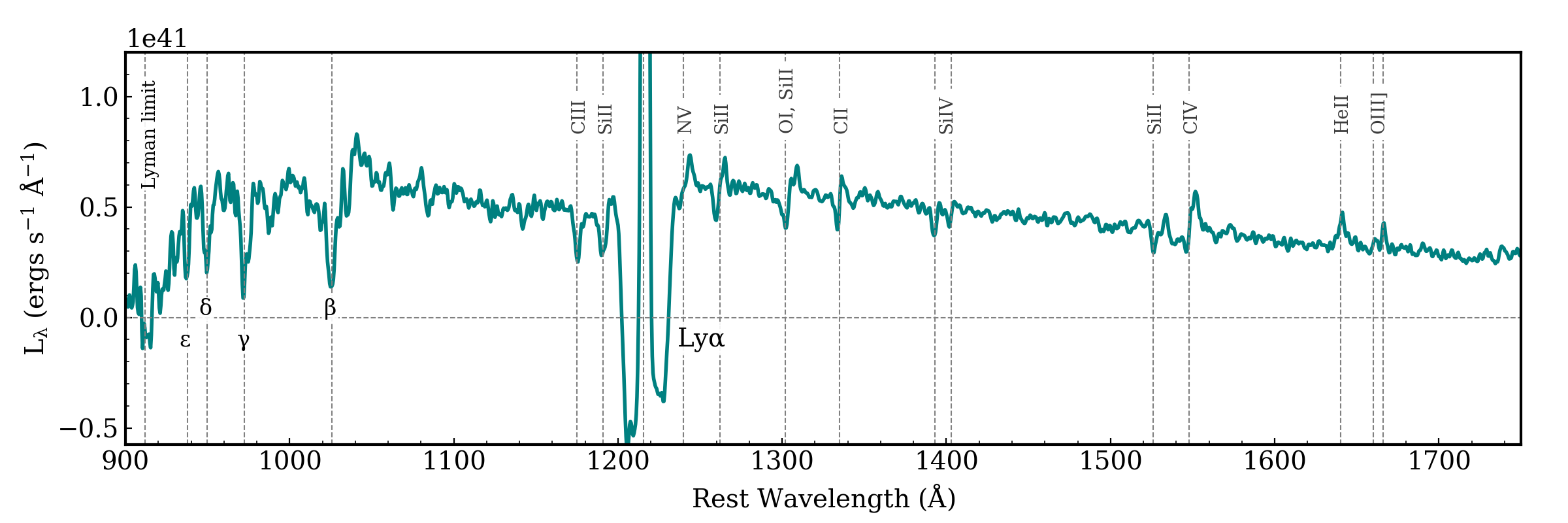
My first couple years in graduate school were spent investigating a puzzling signal found in many of the HETDEX spectra. While not visible in a single spectrum, this signal became apparent in large stacks of data. Around the Lyman alpha emission line were absorption “troughs”, which we at first believed to be unphysical, due to the fact that they were negative. This signal was only present in spectra of LAEs, and was not found in the spectra of stars or other types of galaxies. After a variety of testing, we could not find the potential problem(s), so we were faced with the question: “Is there even a problem?”
Paiting a Picture
If the signal is real, we needed to develop a model to explain it. Noting the signal’s similarity to that of a Damped Lyman Alpha System, we developed the following phenomenological model: background light from faint galaxies gets absorbed by neutral hydrogen in the halo of the LAE. This absorption well superimposed with the spectrum of the foreground LAE produces the shape of the troughs. When the “sky” is subtracted from HETDEX spectra, this background light is subtracted with it, creating the negative absorption (see graphic blelow).
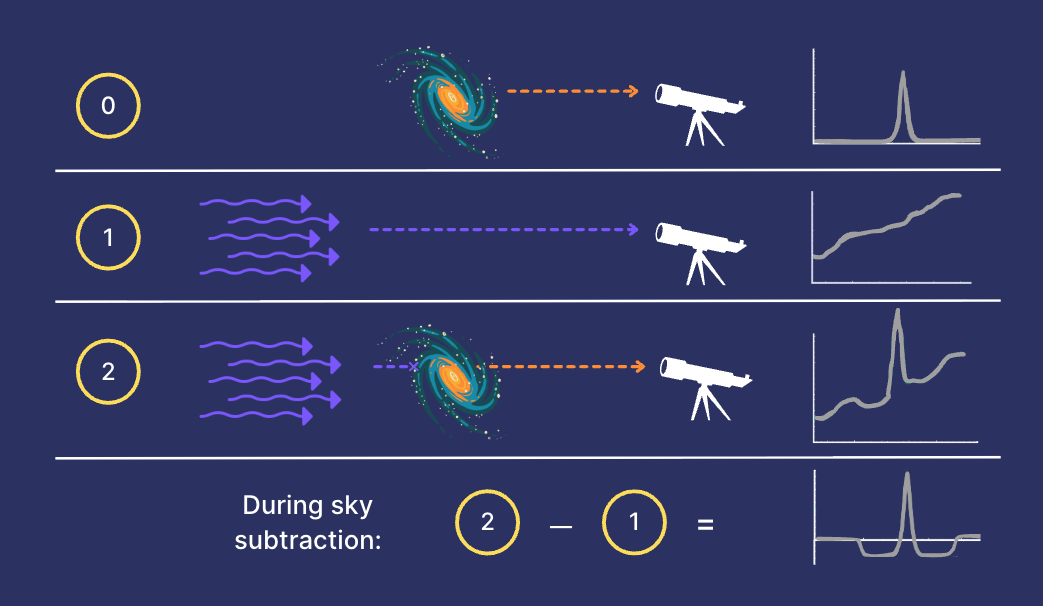
We then noticed that the absorption signal strengthens in galaxies that reside in overdense regions of the sky. More background galaxies → more background light → more negative absorption. Essentially, while the negative troughs themselves are unphysical, they reflect a unique physical phenomenon.
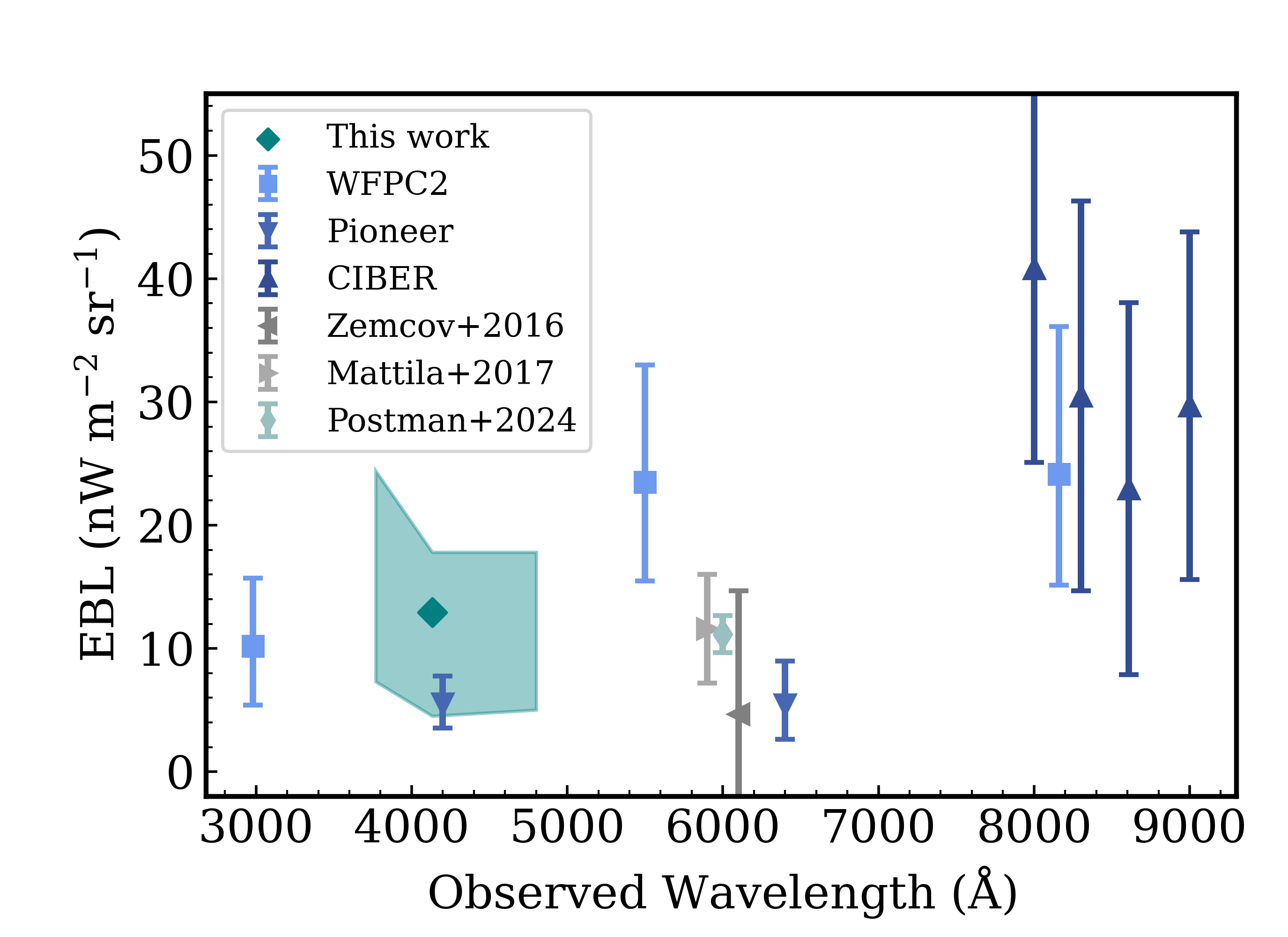
The “background light” that gets absorbed is not trivial either. Extragalactic background light (EBL, and its ultraviolet component, the UVB) is essentially for keeping the intergalactic medium at z~2–3 ionized, when galaxies were rapidly forming. The absorption troughs in HETDEX provide a unique opportunity for measuring the intensity and variability of this light across the sky.